
Servo Motors in Thermoforming Machines: Why Packaging Manufacturers Are Making the Switch
53% of new thermoforming machines sold in 2025 were servo-driven. If you are still running pneumatic or considering a new machine, understanding the servo advantage — energy savings, speed, precision — is the single most important factor in your next equipment investment. This guide explains everything from core servo principles to real-world ROI data from packaging factories.
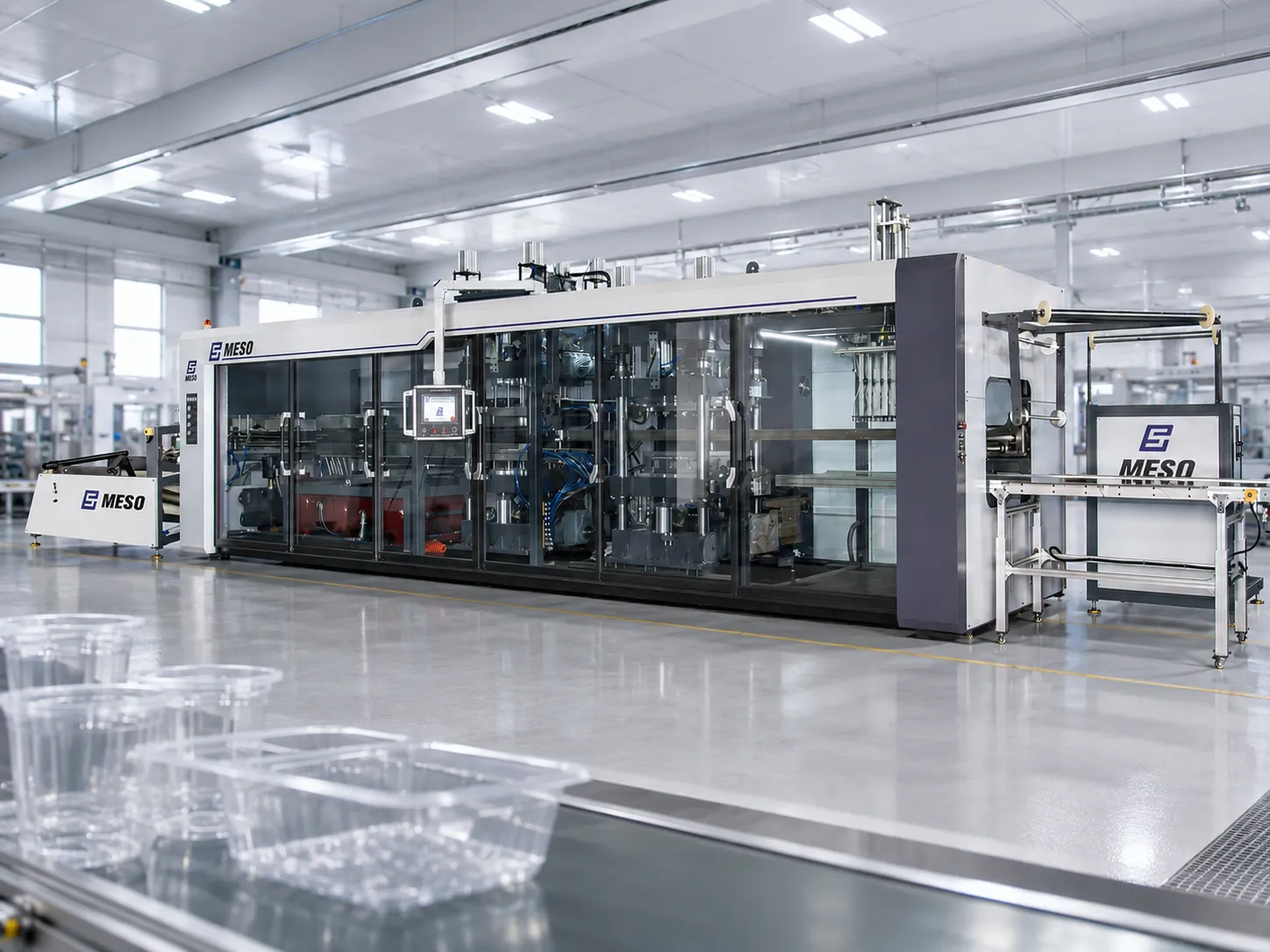
Mesoforming MS720600 servo-driven thermoforming machine — Siemens PLC control, automatic cup stacking, energy-efficient servo motors
Why Servo Motors Are Transforming the Thermoforming Industry
Here is a fact that might surprise you: the same servo motor technology that enables robotic arms to position with 0.01mm accuracy is now standard in high-end thermoforming machines. And for the same reason — precision, energy efficiency, and speed.
In the thermoforming industry, the shift from pneumatic to servo-driven systems is accelerating.
- 53% of new thermoforming machines shipped globally in 2025 were fully servo-driven (Plastics Today, 2026)
- 30-35% average energy reduction when switching from pneumatic to servo
- 50-60% faster cycle times on multi-station servo machines vs equivalent pneumatic models
- 4.7% CAGR global thermoforming machine market growth (Accio Market Research, 2025)
For packaging manufacturers in India, Indonesia, Mexico, and the United States — the fastest-growing thermoforming markets — this shift is a competitive necessity.
Not sure if servo is right for you? Tell us what you are making and your daily output for a custom recommendation and ROI projection. Get Your Recommendation
What is a Servo Motor? (And Why It Matters for Your Thermoforming Machine)
A servo motor is a motor with a feedback system that allows precise control over position, speed, and torque. Unlike a standard motor that simply spins, a servo motor knows exactly where its shaft is at all times — within 0.01 degrees of accuracy.
In a thermoforming machine, this precision translates to:
- Uniform wall thickness — fewer rejects, more consistent quality
- Exact forming pressure at the right millisecond — critical for complex cup geometries
- Plug-assist synchronization — servo-driven assists move in perfect timing with the forming cycle
Reality check: Producing on a pneumatic machine? You are likely running 40% slower cycles and paying 35% more in electricity than a comparable servo machine.
Key Components Applied to Thermoforming
| Component | General Function | In Your Thermoforming Machine |
|---|---|---|
| Brushless AC Servo Motor | Generates precise rotational movement | Drives the forming station up/down with sub-millimeter accuracy at variable speeds |
| ชุดลดเกียร์ | Slows speed, increases torque | Provides high torque for cutting thick materials (PET, PLA up to 1.5mm) |
| Encoder | Tracks shaft position | Ensures mold alignment within +-0.05mm for multi-cavity cup production |
| วงจรควบคุม | Processes feedback signals | Adjusts forming pressure in real-time based on sheet thickness |
Understanding Total Energy Consumption in Thermoforming
When evaluating energy savings from servo technology, it is important to understand where energy is actually consumed in a thermoforming machine. The heating section — the infrared ceramic or quartz heaters that bring plastic sheets to forming temperature — accounts for 60-70% of total machine energy consumption. The drive system (motors, hydraulics, pneumatics) makes up the remaining 30-40%.
The 30-35% energy savings from switching to servo drives applies specifically to the drive system portion of total consumption. In real terms, this translates to approximately 12-18% reduction in total machine electricity costs — still a significant figure that typically delivers $4,800-$15,600 in annual savings depending on local electricity rates and production volume.
For the most accurate ROI projection, Mesoforming provides a detailed energy breakdown showing heating vs. drive consumption at your specific production parameters before purchase.
Servo vs Pneumatic: Honest Comparison
This is the question we answer most. Real production data — not marketing.
| Factor | Servo-Driven | Pneumatic |
|---|---|---|
| Upfront Cost | 30-50% higher | Lower initial investment |
| การใช้พลังงาน | 0.12-0.18 kWh/1000 cups | 0.20-0.28 kWh/1000 cups |
| Cycle Speed | 28-35 cycles/min (4-station) | 18-22 cycles/min (3-station) |
| Position Accuracy | +-0.05 mm | +-0.3 mm |
| ระดับเสียง | 65-72 dB | 80-90 dB |
| การบำรุงรักษา | Low — no seals or compressors | High — seal replacement, oil changes |
| Material Waste | 3-5% scrap rate | 6-10% scrap rate |
| Payback | 12-18 months | — |
Real case: A Gujarat, India factory switched from pneumatic to Mesoforming MS720600. Per-cup energy dropped from $0.008 to $0.005. At 1.2M cups/month — $3,600/month savings. The machine paid for itself in 14 months.
How Servo Motors Work in Your Thermoforming Machine
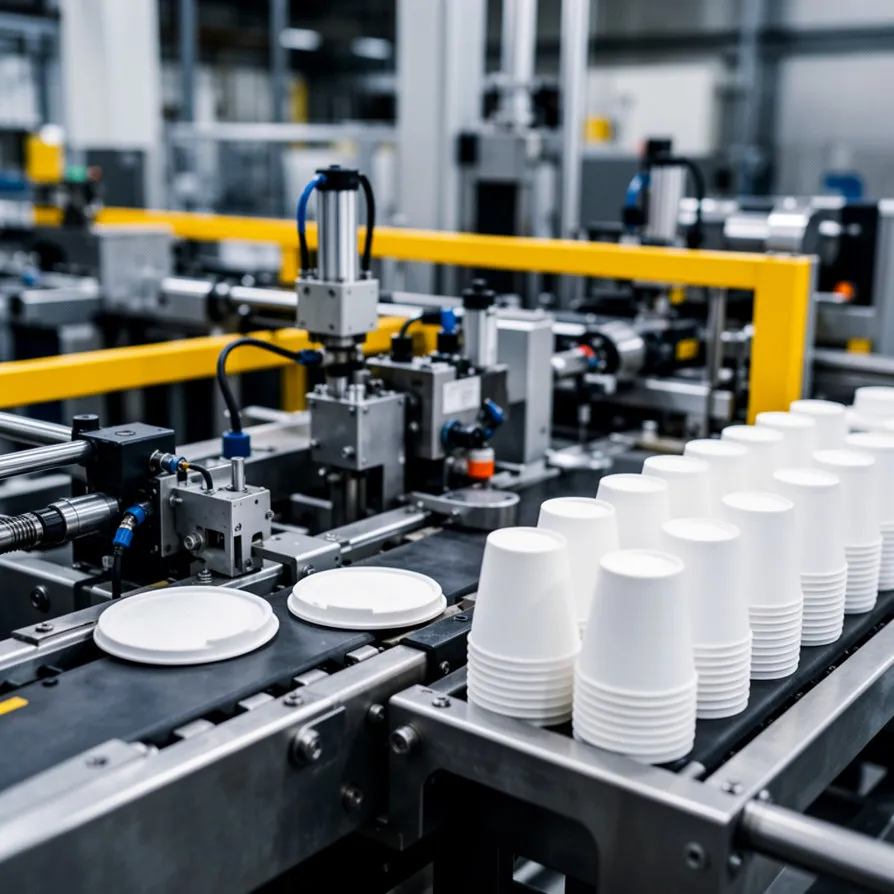
In a multi-station machine (heating, forming, cutting, stacking), servo motors coordinate the entire cycle through a centralized PLC:
- PLC sends command signals to the servo drive based on programmed forming parameters
- Servo drive interprets the signal and adjusts current to maintain exact positioning under varying loads, using a high-resolution encoder for sub-millimeter accuracy
- Encoder reports actual position — compensates for resistance or overshoot in real-time
- Forming station moves precisely — sheet advances 650mm, mold closes to +-0.05mm in under 3 seconds
Key advantage: servo motors consume power only when moving. Pneumatic compressors run continuously — even when not forming. This is the 30-35% energy gap on the drive system portion.
Energy Savings by Region
| ประเทศ | Avg Rate | Annual Savings* |
|---|---|---|
| India | $0.08/kWh | $4,800 — $6,200 |
| Indonesia | $0.10/kWh | $6,000 — $7,800 |
| Mexico | $0.12/kWh | $7,200 — $9,400 |
| United States | $0.12/kWh | $7,200 — $9,400 |
| Brazil | $0.16/kWh | $9,600 — $12,500 |
| Europe (avg) | $0.20/kWh | $12,000 — $15,600 |
* Single shift, 22 days/month. Double for two-shift operations.
5 Mistakes to Avoid When Buying a Servo Thermoforming Machine
Don not Fall for These Traps
- Buying a servo machine that is actually pneumatic with one servo axis. Verify how many axes are fully servo. Mesoforming machines have servo on forming, plug assist, and sheet indexing as standard.
- Ignoring PLC brand. Cheap PLCs cannot fully utilize servo capabilities. Mesoforming uses Siemens — the global standard.
- Not accounting for mold compatibility. Servo machines need molds designed for faster cycles. Mesoforming includes mold optimization with every turnkey package.
- Assuming all servo machines save the same energy. Real savings depend on drive tuning and production profile. Ask for documented data.
- Skipping after-sales support evaluation. Servo components need specialized support. Mesoforming has 6 in-house servo engineers with 4-hour remote response.
Want to verify? Schedule a live video factory tour. We run your material on a Mesoforming servo machine — you watch cycle time, energy consumption, and quality in real time. Book Video Tour
Mesoforming Servo-Driven Thermoforming Machines
All machines below use Siemens servo motors and PLCs, CE and ISO 9001:2015 certified.
Frequently Asked Questions About Servo Thermoforming Machines
Quick answers to the most common questions buyers ask before purchasing a servo-driven thermoforming machine.
01 Why are servo motors better than pneumatic systems in thermoforming?
02 How much annual savings can I expect from a servo thermoforming machine?
03 What brand of servo motors does Mesoforming use?
04 What is the payback period for a servo-driven thermoforming machine?
05 Can I retrofit my existing pneumatic machine with servo motors?
06 What maintenance does a servo thermoforming machine require?
07 How does servo control improve cup wall thickness uniformity?
08 What materials can a servo thermoforming machine process?
09 How does servo control handle different material thicknesses?
10 What certifications do Mesoforming servo machines have?
11 What after-sales support does Mesoforming provide for servo machines?
12 How long does it take to train operators on a servo machine?
13 What is the noise level of a servo vs pneumatic thermoforming machine?
14 Can servo machines produce PLA and biodegradable material products?
15 What is the warranty period for Mesoforming servo machines?
16 How do I verify a supplier claims about servo motor performance?
17 What is the delivery time for a servo thermoforming machine?
18 Is mold design different for servo vs pneumatic thermoforming machines?
19 Do servo machines work with recycled plastic materials?
20 How do I get started with a Mesoforming servo thermoforming machine?
เกี่ยวกับ เมโซฟอร์มมิง
Shantou Mingsu Machinery Co., Ltd. is a China-based manufacturer of servo-driven thermoforming machines since 2013. 500+ customers in 50+ countries. CE (TUV Rheinland) and ISO 9001:2015 (SGS) certified. In-house mold making, CNC machining, and full machine assembly.
